What is AI and how can it help if you have Parkinson’s?
The term ’Artificial Intelligence’ (AI) seems to be everywhere these days. Here’s what you need to know.
Artificial Intelligence (AI) might feel like a bit of a mystery if you’re not keeping up with the latest tech buzzwords, but chances are you’ve encountered AI content in the last year – whether you wanted to or not.
If you’ve scrolled through Facebook or even searched something in Google recently, you’ve probably come across text and images generated using AI. You might not have even realised you were interacting with AI, as the technology has become more sophisticated and convincing to even the trained eye at an alarming rate.
Not to be left behind, healthcare apps and medical research fields have also been leveraging AI recently. The question is, how can AI help you as a person with Parkinson’s? And, just as crucially, how far should you trust this largely unregulated technology?
What is AI?
The term ‘AI’ refers to a computer’s ability to perform advanced tasks typically associated with human intelligence. Examples include learning, reasoning, decision-making and problem-solving.
Though it’s been more than 70 years since computer scientists began working on AI, the technology has made huge strides in recent years thanks to big investments in Large Language Models (LLMs).
Scientists applied complex maths to a huge amount of data they took from the web. Using this data, they created systems that could produce entirely new text and images comparable to that they were trained on. This makes them better at producing text that feels ‘human’ than ever before. The systems are called Large Language Models due to the fact they‘re based on a large amount of data about language, and because they imitate or ’model’ human language. Other similar systems are trained on images, and can produce new pictures that imitate real ones. Because all of these systems generate new content, they‘re called ’generative’ models.
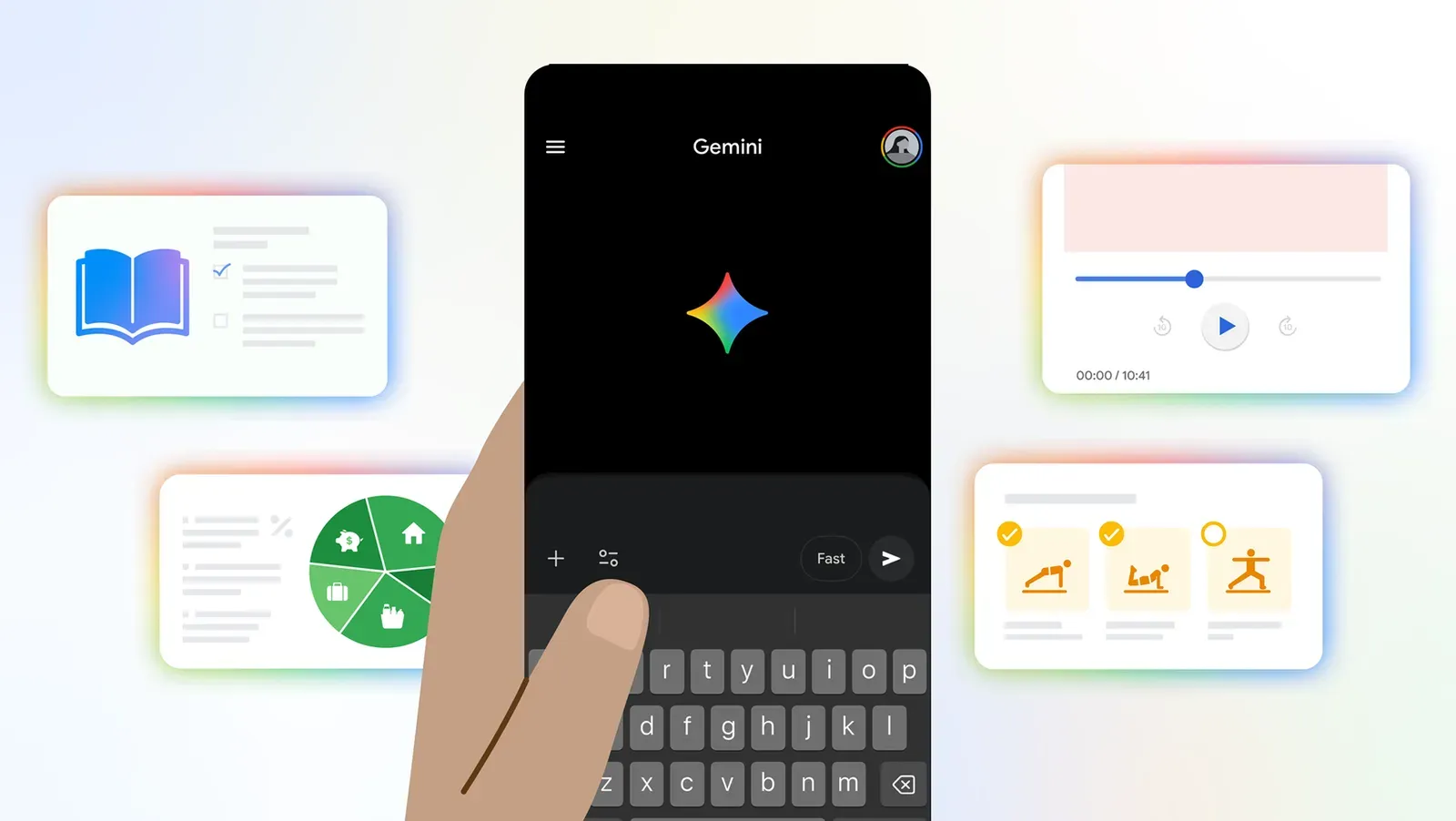
LLMs are also the backbone behind chatbots like ChatGPT and Google Gemini, allowing them to generate detailed bodies of text and making it possible for image generators to paint realistic visuals from scratch.
These days, it can feel almost impossible to find an app or service that hasn’t integrated AI in some way – and healthcare apps are no exception.
How can AI help if you have Parkinson’s?
There are several apps in our Tech Guide catalogue that leverage AI in their services. Some examples include:
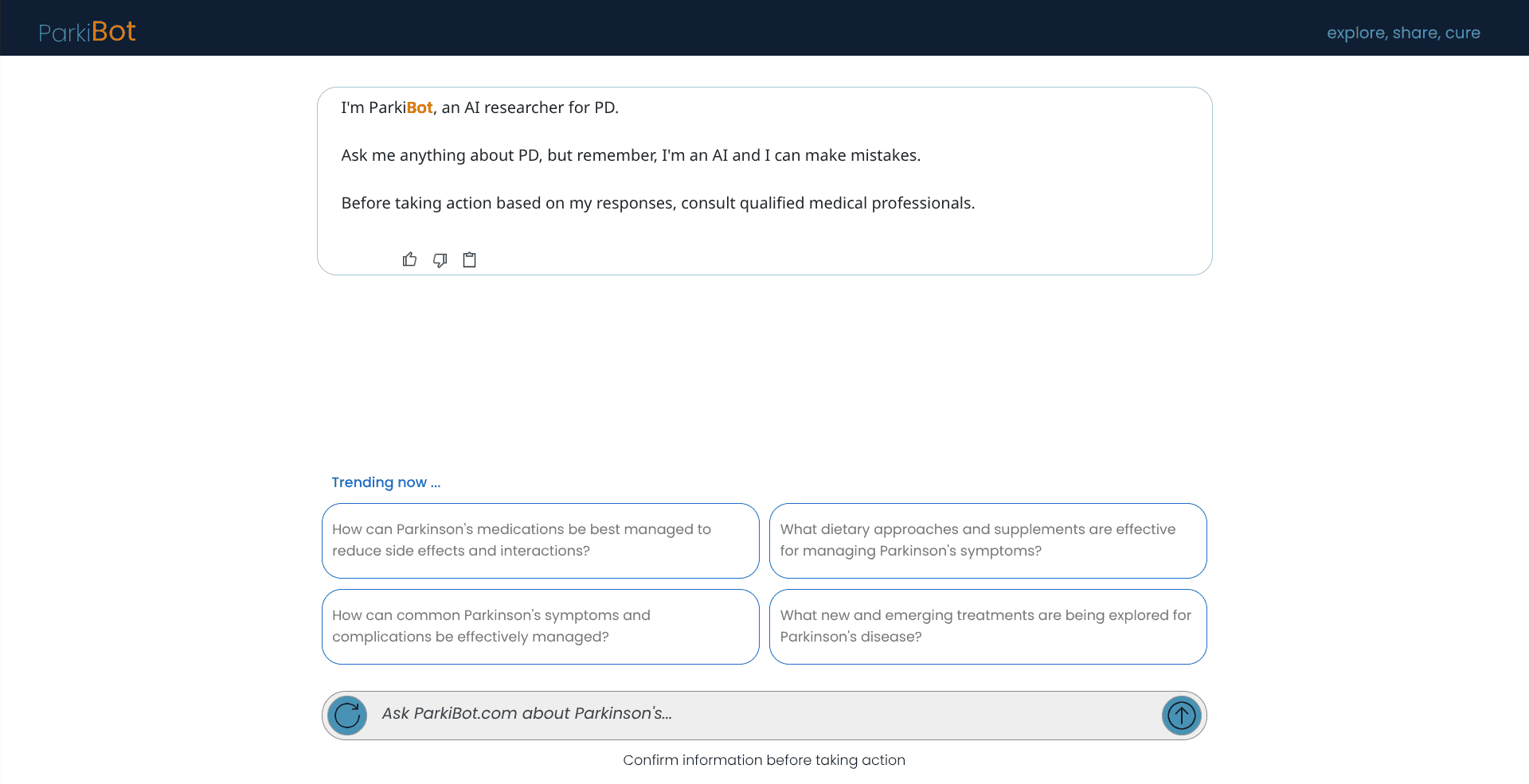
- ParkiBot: A chatbot designed specifically to answer questions about Parkinson’s.
- PD Buddy: A symptom-tracking app with an AI assistant that provides daily advice on how to better manage your symptoms.
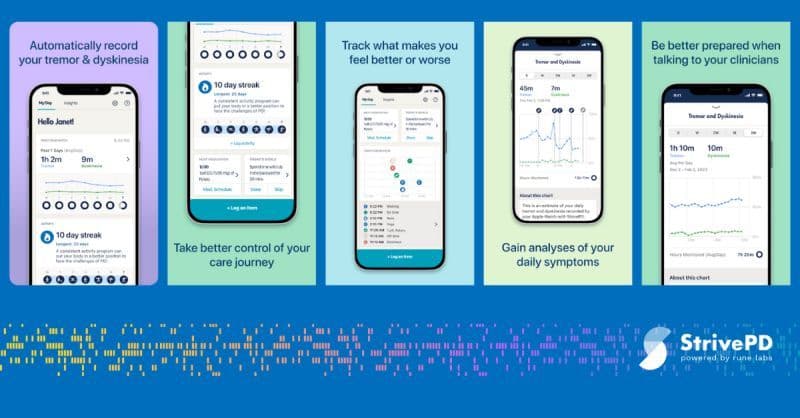
- StrivePD: A tremor and dyskinesia-monitoring app that features an AI care companion.
- Whispp: An app that uses AI to convert whispered or vocal cord-impaired speech into a clearer, natural-sounding voice during phone calls.
Of course, you can also use chatbots like ChatGPT and Gemini to learn more about the condition, find new ways to manage your symptoms and connect with resources.
That being said, we don’t recommend taking any medical advice from AI without checking with more-reliable sources, and, ideally, consulting your doctor or healthcare provider. LLMs take their knowledge from a variety of online sources, and that information can too often be outdated, conflicting or outright wrong.
Is AI helping Parkinson’s research?
Complex computer systems have long been used in medical research. Machine-learning systems can identify cancers in medical scan images as well as doctors. The technology has also been used to diagnose Parkinson’s and identify drivers of the condition in recent years – including in Parkinson’s UK’s own Brain Bank.
In 2022, a team from the Parkinson’s UK Brain Bank at Imperial College London, NHS England, Parkinson’s UK, and AI specialists Polygeist set out to investigate if AI could be used to improve the speed and accuracy of Parkinson’s diagnoses. They found that, of 300 people with a Parkinson’s diagnosis and 50 without, the AI model was able to diagnose Parkinson’s with greater than 93% accuracy in just 4 minutes. Learn more about that research hereopens in new tab.
A year later, research published in Nature Machine Intelligence showed that an AI system could identify which of the four altered pathways in the body was the key driver of a person’s Parkinson’s with 95% accuracy. This is information that could be used to subtype Parkinson’s in the future in order to develop more personalised treatments. You can learn more about that study hereopens in new tab.

More recently, researchers at University College London have developed a new blood test which they say is 100% accurate in identifying Parkinson’s. The team reached this conclusion by using AI to analyse more than 1000 different proteins in blood samples and identifying the subtle changes in eight proteins consistently found in those with Parkinson’s. You can find more information about that research hereopens in new tab.
Why might I not want to use AI?
Like the internet itself, there are positive and negative sides to AI. While machine learning and LLMs have the potential to be life-changing for people with Parkinson’s, the downsides could be equally catastrophic.
Many people and environmental groups have raised concerns about the impact of AI on the planet. Data centres require vast amounts of electricity to train and run AI models, as well as huge volumes of water to keep them cool. This big increase in demand for electricity to power the new data centres has led to a big increase in the burning of fossil fuels to create that electricity. Furthermore, manufacturing all those new computer systems also creates electronic waste, which can include hazardous substances, like lead and mercury, according to the UN Environment Programmeopens in new tab.
There are also questions surrounding the ethics of AI and the industry remains largely unregulated in terms of sustainability, safeguarding and its development. All LLMs have been trained using content scraped from the web without permission. This means that your writing, artwork or even social media posts have probably been used by large companies to build machines that can generate new text and images like yours, all without your knowledge or consent.
The good news is that the EU passed its Artificial Intelligence Act in 2024. This prohibits certain uses of AI and requires companies to be more transparent if they operate in the EU, which is likely to impact the tech industry outside of the EU too. However, while General Data Protection Regulation (GDPR) touches on the topic of AI in terms of personal data, there is currently no AI-specific regulation in the UK.
Aside from the ethical implications of using AI, the technology is also susceptible to getting things wrong.
New health advice and research is published constantly, meaning the training data behind LLMs becomes out of date as soon as a new update is released. The BBC published a study that examined more than 3,000 responses from ChatGPT, Copilot, Gemini, and Perplexity. This study found that 45% of all answers provided by these chatbots had at least one significant issue.
Furthermore, AI models are designed to please you so that you’ll keep interacting with them. This means they might not correct you if you present them with an incorrect idea.